5,000, 10,000 or 28,000 millimetres? Short answer: 10,000 mm is sufficient for everyday use, 15,000–20,000 mm or more for long days out in northern Norwegian rain and wind. Here is what the numbers measure, what EN 343 requires of workwear rainwear, and what sets rainwear apart from a shell jacket.
In brief
- The water column rating measures how much water pressure a fabric can withstand before it leaks, expressed in millimetres. A higher figure tolerates more pressure — from rucksack straps, knees on wet ground and wind-driven rain.
- 5,000 mm is sufficient for a rain shower. 10,000 mm is a reasonable everyday level. For long days out in northern Norwegian rain and wind we recommend 15,000–20,000 mm or more.
- The figure says nothing about seams, zips or breathability. A jacket without taped or welded seams will leak regardless of the water column rating.
- Classic PU rainwear is completely waterproof and affordable, but does not breathe. Shell jackets with a membrane breathe, and are what you want when you are on the move.
- Prices in the guide are rounded to the nearest krone and include VAT.
What is the water column rating?
The water column rating is measured by clamping the fabric beneath a tube that is filled with water. The height of the water at the point it begins to seep through is the water column rating. 10,000 mm means the fabric withstood the pressure of a ten-metre column of water.

Raindrops alone do not exert much pressure. What forces water through fabric is load: rucksack straps, sitting down on a wet rock, kneeling in the heather or standing in a gale with rain driving straight into your chest. That is why hikers and tradespeople need higher ratings than someone walking from the car to the shop.
| Water column | Withstands | Typical use |
|---|---|---|
| Under 5,000 mm | Light rain, short duration | Wind jackets and water-repellent garments — not rainwear |
| 5,000 mm | Rain showers | Short trips, affordable workwear rainwear for shorter sessions |
| 10,000 mm | Sustained rain over shorter periods | Everyday, town, the school run, light hikes |
| 15,000–20,000 mm | Heavy rain over time, rucksack and sitting pressure | Hiking, outdoor work, northern Norwegian autumn |
| 28,000 mm | Very high pressure over a long time | Mountains, multi-day trips, rescue — typically Gore-Tex |
The categories are the same as in our shell jacket guide, where you will also find explanations of membranes, 2-, 2.5- and 3-layer construction and breathability. We will not repeat them here.
Is a 10,000 mm water column rating enough?
For everyday use, yes. For a full day outdoors in Troms in October, often not. Up here, rain rarely falls straight down — it comes sideways on the wind, and it lasts. If you are carrying a rucksack or working on your knees, the pressure on the fabric rises quickly.
Our recommendation: 10,000 mm for town, commuting and play at nursery. 15,000–20,000 mm for hiking and outdoor work. 28,000 mm if you spend a lot of time in the mountains or want one jacket that can handle everything for many years.
Bear in mind that the water column rating applies to the fabric when new. Wear, dirt and washed-out DWR treatment cause the outer fabric to absorb water. The jacket will then feel wet and cold even if the membrane is not leaking.
What does the standard require? EN 343 explained
For leisure clothing there is no legally required threshold for what may be called waterproof. The figure on the label is the manufacturer's own, measured using the hydrostatic method in EN ISO 811. For protective clothing against rain it is different. There, the standard EN ISO 24232 (formerly EN 343) applies, dividing garments into classes for waterproofness and breathability:
| Class | Waterproofness (EN 343:2019) | ≈ water column | Breathability (Ret) |
|---|---|---|---|
| 1 | At least 8,000 Pa, tested without pre-treatment | approx. 800 mm | Above 40 — limited wearing time |
| 2 | At least 8,000 Pa after pre-treatment | approx. 800 mm | 25–40 |
| 3 | At least 13,000 Pa after pre-treatment | approx. 1,300 mm | 15–25 |
| 4 | At least 20,000 Pa after pre-treatment, seams included | approx. 2,000 mm | 15 or lower |
Ret is the resistance to outward moisture vapour transmission. The lower the figure, the better the garment breathes. Pre-treatment means the fabric has been washed, abraded and flexed before the test — the requirement therefore applies to a used garment, not a new one.
Note that the requirements are considerably lower than the figures you see on leisure jackets. This does not mean that an EN 343 jacket is inferior: the standard measures in a different way, on pre-treated fabric and seams, whereas 20,000 mm on a hiking jacket is measured on new fabric. The figures cannot therefore be compared directly.
EN 343 has now been replaced by EN ISO 24232:2025 (published in Norway on 3 November 2025), with the same classes and the same pictogram, but with revised test methods and new requirements for the durability of the outer fabric. You will therefore gradually see «ISO 24232» on new garments. Certificates issued under EN 343 remain valid until their expiry date.
Rain jacket or shell jacket — what is the difference?
Classic rain gear is made from polyurethane (PU) or PVC-coated fabric with welded seams. It is completely waterproof, withstands mud and salt water, is easy to rinse clean and costs little. The drawback is that it does not breathe: if you move quickly, you will get wet from the inside. Many PU garments, such as Helly Hansen's Moss range, therefore do not state a water column rating at all — they are simply sealed.
Shell jackets have a membrane that allows water vapour to escape while keeping rain out. They are lighter, more flexible and work year-round as an outer layer over wool and mid-layers. See the layering guide for how the layers work together.
In short: if you are standing still, fishing, working on the quayside or collecting children from nursery — PU rain gear. If you are hiking, cycling or out all day in changeable weather — a shell jacket.
A third option is the poncho. Fjällräven Poncho (1 599 kr) covers both you and your rucksack, is PU-coated with a stated 5 000 mm rating and breathes better than a rain suit because air circulates underneath.
Browse the range: women's rain jackets · men's rain jackets · workwear rain gear · work rain trousers.
Rain jackets and shell jackets with stated water column ratings
Compared by water column rating, construction, intended use and price. We have not tested the jackets in a laboratory and do not name a winner; the figures are the manufacturers' own, as they appear in our product data. Where the manufacturer does not state a water column rating, it reads «not stated». Prices include VAT.
| Model | Brand | Water column / construction | Suitable for | Price |
|---|---|---|---|---|
| Moss Rain Coat | Helly Hansen | Helox+ PU, welded seams. Water column not stated (sealed PU) | Town, everyday use, boat and quayside | 1 599 kr |
| Varja Wns Jkt 2 / Dario Unisex Jacket 2 | Didriksons | 15 000 mm, taped seams | Affordable all-round rain jacket for everyday use and hiking | 1 400 kr |
| Tilde Wns Jkt 4 | Didriksons | 10 000 mm | Everyday use and town | 1 900 kr |
| Biak Unisex Jacket | Didriksons | 10 000 mm, breathability 5 000 g/m²/24 h | Everyday use, low activity | 2 300 kr |
| Torrentshell 3L Rain Jacket | Patagonia | 3-layer H2No Performance Standard. Water column not stated in our data | Hiking, travel and everyday use — packs into its own pocket | 3 299 kr |
| Norste XT Jacket | Montane | Pertex Shield, 20 000 mm, breathability 20 000 g/m²/24 h | Active hiking in wet weather | 3 299 kr |
| Cetus Jacket | Montane | 20 000 mm | Mountain hiking and year-round use | 3 800 kr |
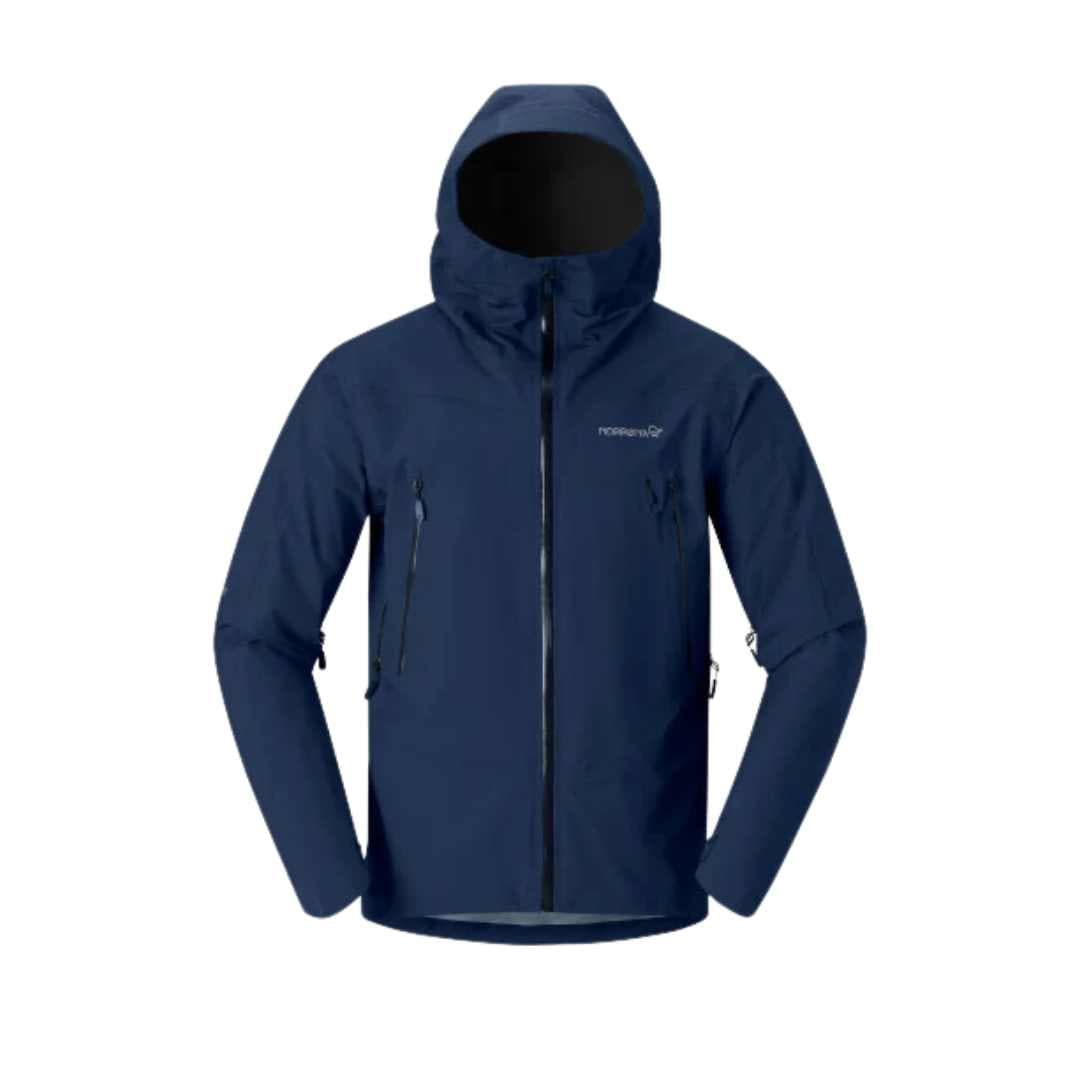
| falketind Gore-Tex Jacket | Norrøna | 3-layer Gore-Tex ePE, 28 000 mm | Mountain, multi-day trips, one jacket for everything | 5 999 kr |
More models can be found under women's shell jackets and men's shell jackets. You will also need rain trousers: HH Rain Pant (women's) at 999 kr is a two-layer everyday trouser with sealed seams, and Patagonia Torrentshell 3L Rain Pants (2 499 kr, women's) have a zip from the knee downwards so you can put them on over your shoes. See women's shell trousers and men's shell trousers.
What about children?
Children sit, crawl and slide around in their rain gear. In that case, welded seams, durable fabric and easy cleaning matter more than breathability — classic PU rain gear is usually the right choice for nursery and play, while older children who hike or cycle to school benefit more from breathable shell clothing. The children's range can be found under junior.
Helly Hansen Jr Moss Jacket (799 kr) is a typical example: Helox+ PU with welded seams, a reflector on the chest, and it comes with a repair kit.
Rain gear for work
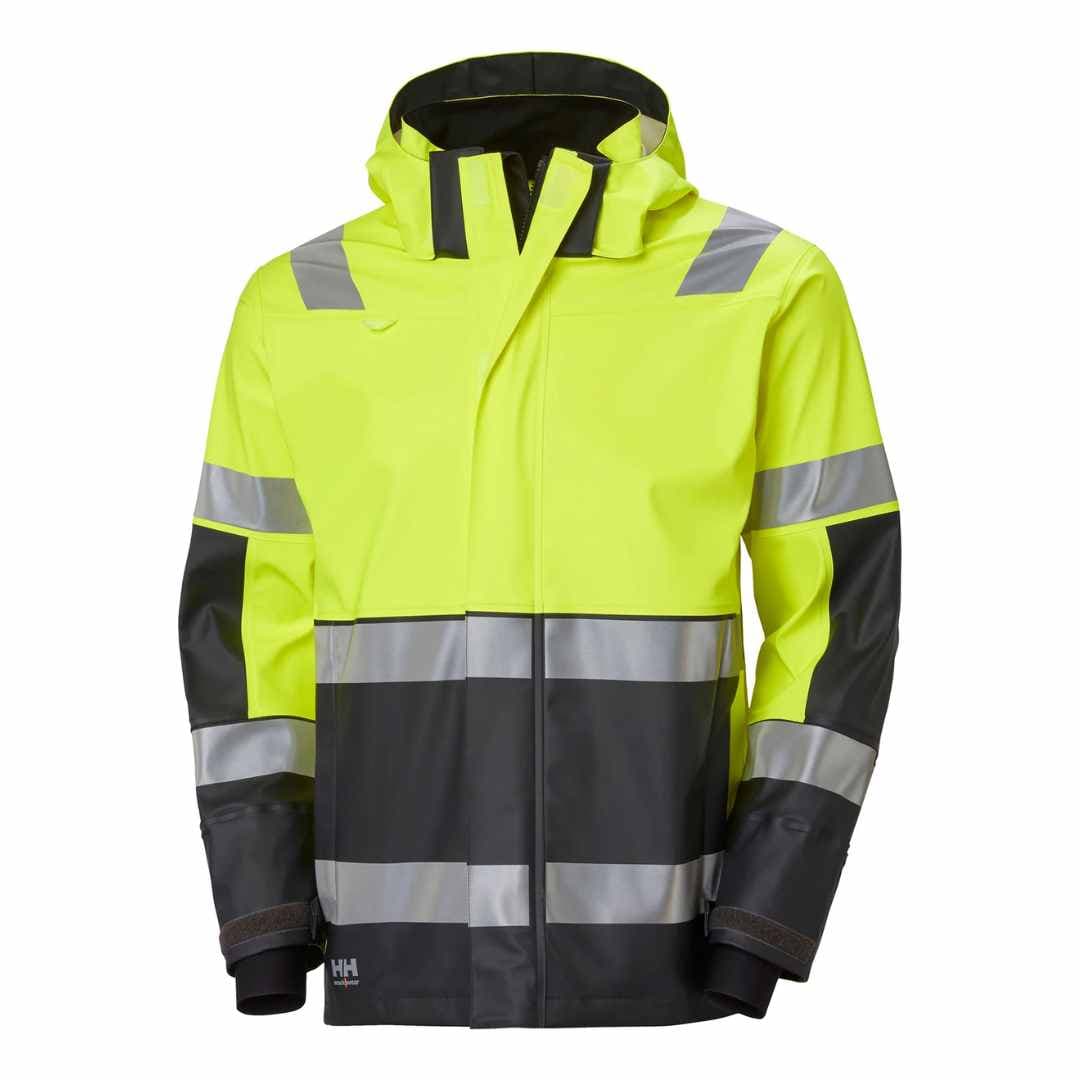
Workwear rain gear often needs to meet more than just being waterproof. EN ISO 24232 (formerly EN 343) is the standard for protective clothing against rain and specifies classes for both water resistance and breathability; EN ISO 20471 covers visibility. We have written about what employers are required to provide in the guide to HSE requirements for workwear.
Prices below include VAT and are rounded to the nearest krone.
- Lyngsøe Rainwear Jacket — flame-retardant hi-vis in PU-coated polyester at 260 g/m², hood that fits over a helmet, 1 186 kr. The matching bib trousers have a 20 000 mm rating and are certified to EN 343, EN ISO 20471 and EN ISO 14116.
- Helly Hansen Alna 2.0 Hi Vis rain jacket — soft, phthalate-free PU with neoprene cuffs that prevent water from running into the sleeves when you work with your arms above your head, 2 249 kr.
- Helly Hansen Addvis Rain Coat — PU rain coat, certified for visibility (hi-vis class 3) and rain (EN 343), 1 936 kr.
- Lyngsøe Rainwear Trousers — rain trousers in PU-coated polyester at 260 g/m², stated rating of over 20 000 mm, zip from the knee downwards, 999 kr.
See everything under workwear rain gear. Companies are welcome to contact our Bedriftssenter regarding corporate discounts and logo branding.
How to keep rain gear waterproof
When water stops beading on the outside, it is the DWR finish that has worn off — not the membrane. Wash the garment with a cleaner designed for technical textiles and re-proof it, for example with Nikwax TX.Direct Spray-On (189 kr) or OrganoTex Wash-In (259 kr). PU rain gear should be rinsed and hung to dry; it should not be re-proofed. The procedure for shell garments is covered in the shell jacket guide.
Free delivery on orders over 899 kr and 30 days' open purchase. Jobb og Fritid has been a specialist retailer in Tromsø since 1988 — come and try the jackets in person at Jekta or Veita, or contact the Bedriftssenter about workwear rain gear.
Sources
- Standard Norge – NS-EN ISO 811:2018 — the method behind the water column figure on leisure jackets
- Standard Norge – NS-EN ISO 24232:2025 — the standard for protective clothing against rain, replacing EN 343
- Standard Norge – NS-EN ISO 11092:2026 — the measurement method for breathability (Ret)
- Fristads – EN 343 / EN ISO 24232 — class 1–4 for water resistance and breathability
- GORE-TEX – Durable Water Repellent (DWR) — why fabric absorbs water when the DWR finish has worn off
- Montane – Norste XT Waterproof Jacket — example of stated water column rating and breathability
Last checked 19.10.2026.