Cold alone is rarely the problem in Northern Norway. It is the combination of wind, moisture and darkness that makes winter work demanding. Here is the approach Bjørn, our workwear specialist, uses when dressing people who work outdoors from November to April.
In brief
- Dress in three layers: wool next to the skin, insulation in the middle, windproof and waterproof on the outside. Cotton against the skin is the most common mistake.
- Look for EN 342 on winter jackets, trousers and suits. The standard covers protection against cold from −5 °C and below. EN ISO 24232 (formerly EN 343) tells you how well the garment keeps out rain and sleet.
- Wind matters more than the thermometer. −10 °C and 10 m/s of wind (fresh breeze) feels like around −20 °C on bare skin.
- During the polar night you need to be visible. If you work near traffic or machinery, you need certified hi-vis — not just a reflective stripe.
- There is no lower temperature threshold in the Working Environment Act. The employer must plan for the cold, and any necessary additional clothing is regarded as protective equipment that the employer pays for.
Why is winter work in the north different?
There are three things that set a winter day on the quayside in Tromsø apart from a winter day on a building site inland.
Moisture. The coast rarely sees the dry, biting cold of inland areas. The norm is a few degrees below zero, sleet and wind off the sea. Wet clothing insulates poorly, which is why a waterproof outer layer matters more here than in places where it is colder.
Wind. Wind strips away the warm layer of air the body creates around itself. Using the wind chill formula that meteorologists use, −10 °C and 10 metres per second is equivalent to a felt temperature of around −20 °C. A windproof outer layer is therefore the single most important garment.
Darkness. In Tromsø the sun stays below the horizon from the end of November to the middle of January. Most of the working day takes place in artificial light or no light at all. Visibility becomes part of how you dress, not an afterthought.
We have explained the general layering method in How to dress in layers. This guide focuses mainly on the winter months and which garments actually hold up — and at the end, on the rest of the year.
What does the regulations say about working in the cold?
Arbeidstilsynet is clear that there are no fixed temperature thresholds in law or regulation. Instead, the employer must plan and make provision for the temperatures that can be expected, summer and winter alike. The experience of cold depends on temperature, wind and moisture together.
Three points worth knowing:
- If ordinary warm clothing does not provide adequate protection against the cold, the employer must make the necessary additional clothing available. Such clothing is regarded as personal protective equipment and is paid for by the employer.
- Some local agreements stipulate that outdoor work stops below −20 °C, but this is set by agreement, not by law.
- The safety representative can halt work in the event of immediate danger to life or health.
Cold reduces manual dexterity, precision and work pace, and causes muscle stiffness. It is therefore a safety issue, not merely a question of comfort. For employers, we have a separate overview in HSE requirements for workwear and protective equipment.
What do EN 342, EN 343 and EN 14058 mean?
- EN 342 — protective clothing against cold, for surroundings of −5 °C and colder. The garment (often a jacket and trousers tested together) is assigned a measured insulation value. This is the marking to look for on a winter jacket, winter trousers and winter suit.
- EN 14058 — garments for cool environments, down to −5 °C. Typically found on lightweight, lined jackets used as a mid-layer or on mild days.
- EN ISO 24232 (formerly EN 343) — protection against rain. Two numbers: the first is water resistance, the second is breathability. Higher is better; 4 is the top class. The new standard uses the same classes, so marking under either standard means the same thing.
- EN 511 — gloves against cold.
- EN ISO 20471 — high-visibility clothing. See Hi-vis class 1, 2 and 3 explained.
Layer by layer: what to put on
| Layer | Product | Brand | Properties | Suitable for | Price |
|---|---|---|---|---|---|
| Base layer | HH Lifa Merino Crewneck | Helly Hansen Workwear | 57% merino wool and 43% polypropylene (Lifa), 215 g/m². The wool insulates, the Lifa fibre wicks moisture away | Anyone who alternates between activity and standing still | 1 249 kr |
| Base layer | HH Lifa Merino Pant | Helly Hansen Workwear | Same material as the top, 215 g/m², gusset crotch | Under winter trousers or a suit | 1 061 kr |
| Mid-layer | Kensington Insulated Jacket | Helly Hansen Workwear | EN 14058. Lightweight insulation (40 g/m²), softshell panels for freedom of movement. Can be worn on its own on mild days | Under a shell or winter jacket when it is cold | 2 499 kr |
| Outer jacket | Oxford Winter Jacket | Helly Hansen Workwear | EN 342 and EN 343. Helly Tech membrane, Primaloft insulation 100 g/m² in the body and 80 g/m² in the sleeves | Tradespeople who need one winter jacket at a reasonable price | 2 499 kr |
| Outer jacket | Bifrost Winter Jacket | Helly Hansen Workwear | EN 342 and EN 343. Helly Tech Professional membrane, blown insulation, Cordura reinforcements | The coldest days and stationary work | 5 749 kr |
| Trousers | 2935 Vinterbukse | Jobman | EN 342 and EN 343. Water column 10 000 mm, taped seams, detachable braces, fleece over the seat, knee pad pockets | All-round winter trousers | 2 613 kr |
| Trousers | Bifrost Winter Bib | Helly Hansen Workwear | EN 342, EN 343 and EN 14404 (knee pads). Fully taped, knee-high zips | Paired with the Bifrost jacket | 4 874 kr |
| Suit | Winter Overall | Jobman | EN 342 and EN 343. Quilted, taped seams, water column 23 000 mm, full-length leg zip | Affordable one-piece suit for machine operators, caretakers and agriculture | 1 999 kr |
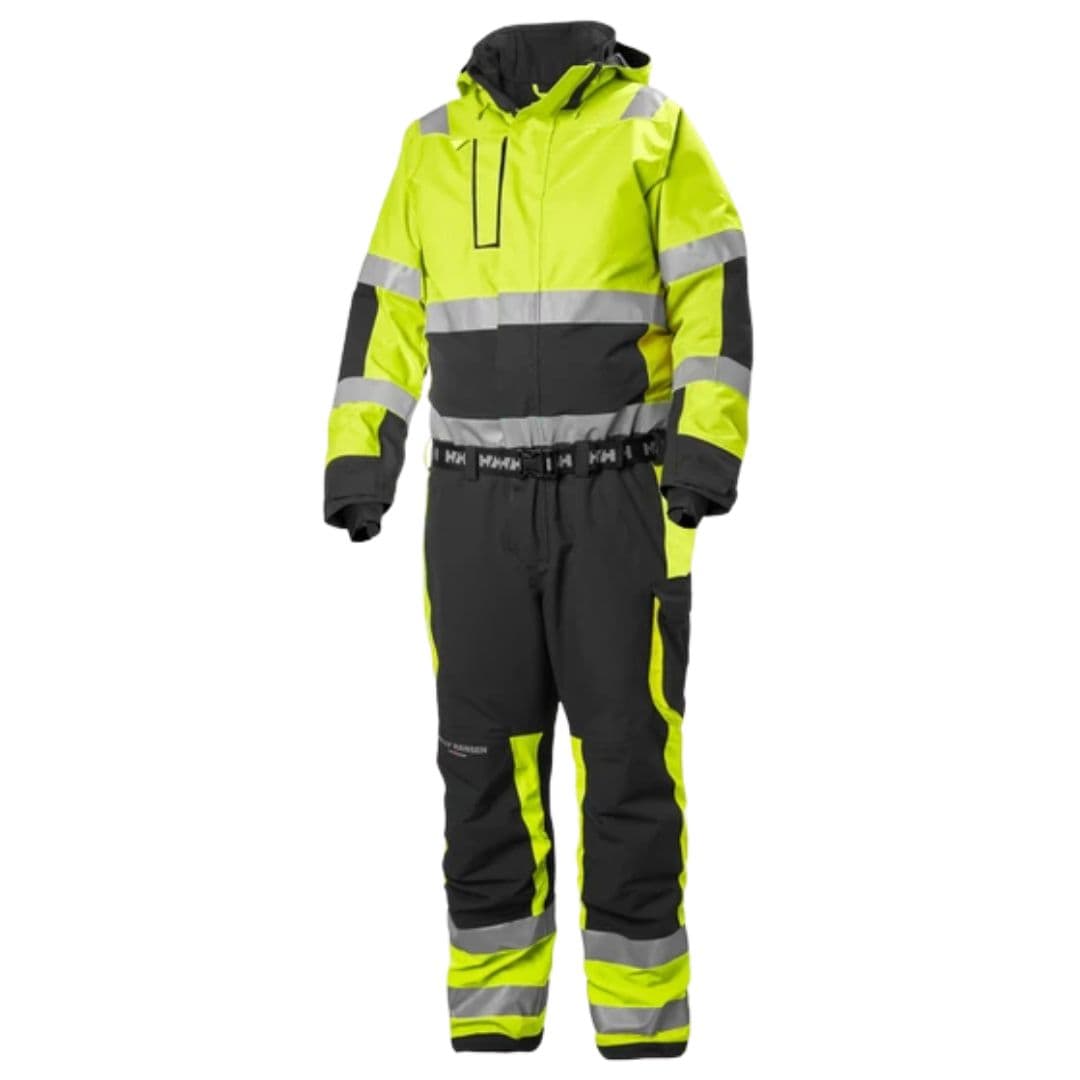
| Suit | Alna 2.0 Hi Vis Fôret Vinterkjeledress | Helly Hansen Workwear | Hi-vis class 3, EN 342, EN 343, EN 14404. Helly Tech membrane, Polartec insulation, helmet-compatible hood | Road, construction and harbour work during the dark season | 6 186 kr |
| Hands | PRO Winter Pro 5-finger | Hestra | EN 388 and EN 511. Goatskin, Thinsulate 40 g | Work where you need the use of your fingers | 649 kr |
| Hands | 295 Vanntett arbeidshanske | Tegera | EN 388 and EN 511. Waterproof membrane, Thinsulate 40 g, goatskin palm | Wet and cold — most affordable waterproof option | 347 kr |
| Hands | PRO Gore-Tex Bas tum | Hestra | EN 388 and EN 511. Mitten with Gore-Tex membrane and fleece lining | Stationary work and the coldest days | 1 299 kr |
| Head | HH Lifa Merino Beanie | Helly Hansen Workwear | 57% merino wool, 43% polypropylene. Double layer over the ears | Under a helmet or on its own | 411 kr |
Base layer: wool, not cotton
Wool keeps you warm even when damp. Cotton does the opposite: it absorbs sweat and sits cold against your skin. If your work involves bursts of activity — lifting, standing, lifting again — it is the base layer that determines whether you get cold during breaks. More options can be found in wool base layers men and wool base layers women.
Mid layer: what you take on and off
The mid layer is your thermostat. A thin lined jacket or fleece that is easy to open is more versatile than a thick jumper. See fleece and jumpers.
Outer layer: windproof and waterproof first, warm second
Choose your outer garment based on how much you move. If you walk a lot, a winter jacket with moderate insulation, such as Oxford, is sufficient. If you stand still by a machine or direct traffic, you need more insulation, such as Bifrost. A one-piece suit is the warmest option because there is no gap at the lower back. Full range: lined winter jackets, lined winter trousers and boiler suits.
Hands, head and feet
The body prioritises the core and cuts blood supply to the fingers and toes first. Always keep a dry pair of gloves in reserve. Mittens are warmer than gloves; a thin wool glove liner inside a mitten gives you both dexterity and warmth. On your feet you need lined safety footwear with a cold-insulated sole (CI) and room for wool socks — see our comparison of safety footwear, which includes several winter models.
The dark season: how to be seen
Fluorescent colour works in daylight and at dusk. When it is completely dark, only the reflective material works, and only when light strikes it. That is why certified high-visibility clothing includes both, with reflective bands around the body, arms and legs so that a driver perceives you as a person in motion.
If you work on roads, at construction sites, in harbours or other locations with vehicles, your winter garment should be hi-vis certified. See hi-vis jackets and hi-vis trousers, and read the explanation of the classes in Hi-vis class 1, 2 and 3 explained. A head torch in your pocket is cheap insurance.
The rest of the year
The layering system is the same in summer and autumn, just lighter: wool or synthetic next to the skin, a fleece as a mid layer on cool days, and a shell or waterproofs on the outside. Choose outer garments that can withstand wear — workwear takes harder punishment than leisurewear.
- Choose a windproof outer layer even on days that seem calm. Wind can pick up quickly, especially in exposed locations.
- Always keep an extra layer in the car or in the site cabin. The weather can change while the working day is still under way.
- For wet weather days: see waterproof workwear and Waterproofs and water column explained.
- Re-proof the outer layer when water stops beading, and wash wool and insulation correctly so they continue to keep you warm. Small tears can often be repaired yourself — see Care and maintenance of shell clothing.
For businesses
If you need to kit out a work team for winter, Bedriftssenteret in Kvaløyvegen 329 can help with selection, fitting and logo application. Business customers receive a business discount and can pay by invoice. See the business pages. Private customers have 30 days' open purchase and free delivery on orders over 899 kroner.
Sources
- Arbeidstilsynet – Temperature: heat and cold at work — no fixed temperature limits, and cold-weather clothing as protective equipment paid for by the employer
- Lovdata – Arbeidsmiljøloven § 6-3 — the safety representative's right to halt dangerous work
- Standard Norge – NS-EN 342:2017 — protective clothing against cold
- Standard Norge – NS-EN ISO 24232:2025 — protective clothing against rain, replacing EN 343
- Yr – Effective temperature and 'feels like' — wind chill
- Yr – Wind arrows and the Beaufort scale — wind speeds in m/s
Last checked 19.10.2026.