Seven safety shoes from our own stock, compared on specifications, intended use and price. We have not carried out laboratory tests — we have read the data sheets and added what we observe in our shops in Tromsø.
In brief
- There is no single «best safety shoe» for everyone. The right shoe is the one that meets the protection class your job requires and that you can wear comfortably for eight hours.
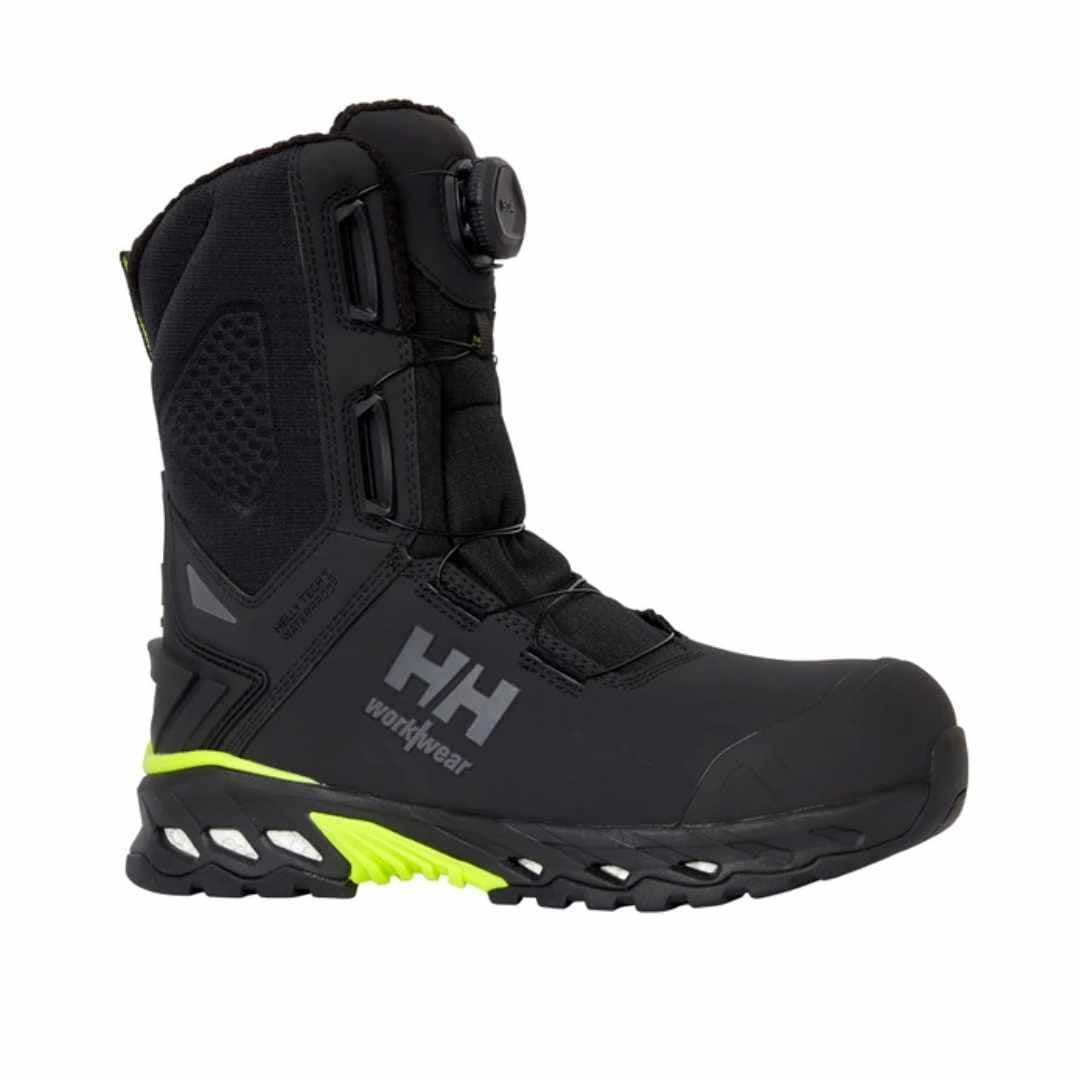
- If you work outdoors in a Northern Norwegian winter, look for S7 (waterproof membrane), CI (cold-insulating sole) and lining. Our recommendation: Helly Hansen Kensington MXR Winter Mid BOA S7S HT.
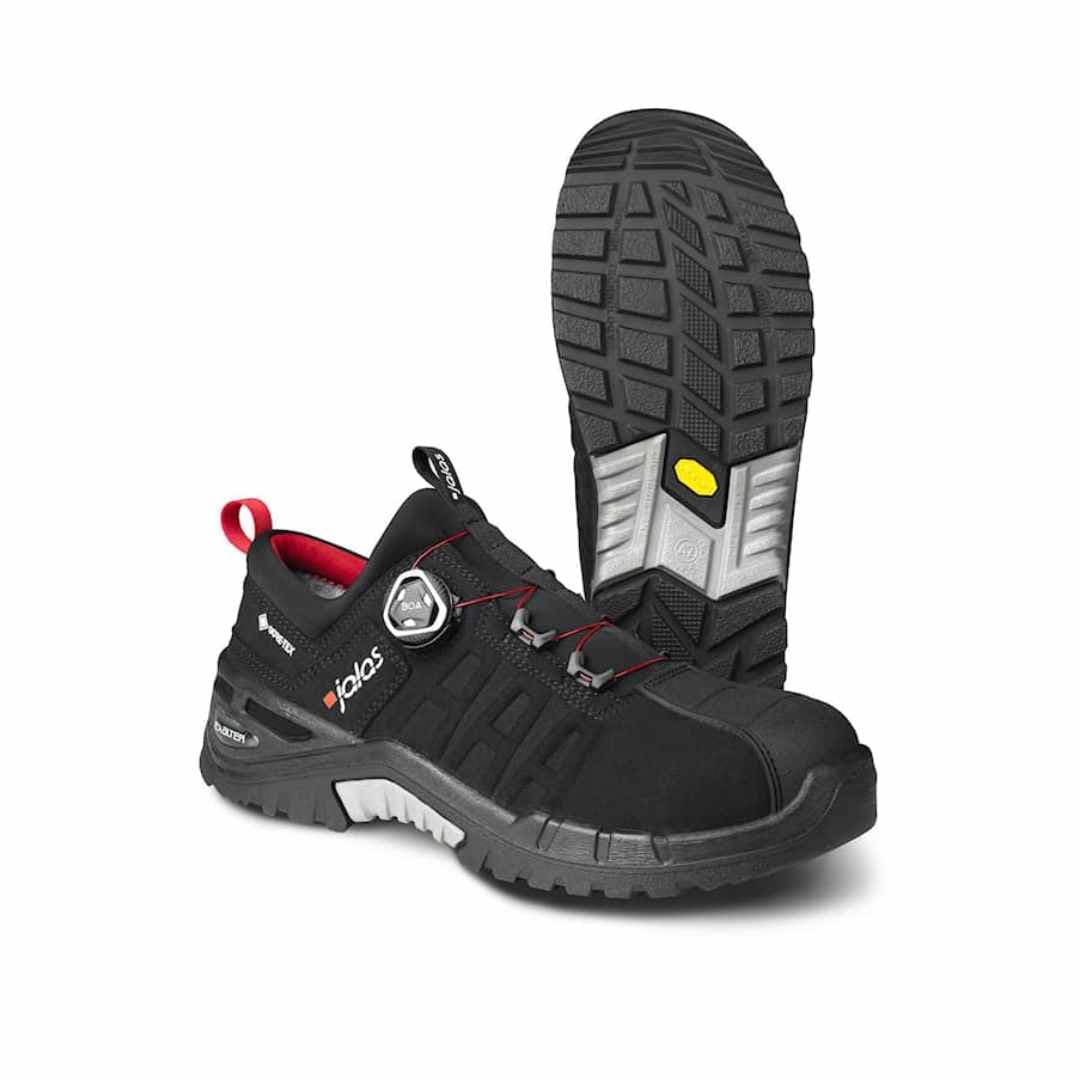
- If you spend long periods standing on hard floors indoors, choose a low, lightweight shoe with good cushioning. Our recommendation: Jalas Exalter 9995 (S3S).
- If you need one shoe for wet year-round use, a shoe with a waterproof membrane is the safest choice: Jalas Exalter 9968 GTX (S3 with WR and Gore-Tex).
- The cheapest S3 shoe in the comparison is Jalas Gran Premio 1508 at 3,083 kroner.
- This is a comparison based on specifications, intended use and price — along with our experience from the shops. We have not tested the shoes in a laboratory and we are not declaring any «test winner».
How we have compared
We started with safety shoes we actually have in stock, and compared what the manufacturers state in their data sheets: protection class according to EN ISO 20345, additional markings (ESD, CI, HRO, SR), toe cap, midsole protection, membrane, lining, fastening and price. Where a manufacturer does not state a particular property, we have left the field blank rather than guess.
We have also drawn on what we see in the shops. Bjørn, who is our specialist responsible for workwear, sees the same pattern year after year: when a safety shoe is replaced, the reason is almost always fit, rarely protection class. Jobb og Fritid has been a specialist retailer in Tromsø since 1988, and safety shoes have been part of the range throughout.
Not sure what S1PS, S3S and S7L mean? You should first read our guide to safety shoe protection classes. Here we only repeat what you need in order to read the table.
Comparison table: 7 safety shoes
| Model | Brand | Class and properties | Suited to | Price |
|---|---|---|---|---|
| Kensington Low BOA S3 | Helly Hansen Workwear | S3S, ESD, SR, HRO, FO. Low cut. Composite toe cap, water-resistant knitted upper, BOA | Tradespeople who walk a lot, indoors and outdoors in dry or light weather | 3,124 kr |
| Exalter 9995 | Jalas | S3S, HRO, FO, SC, ESD. Low cut. Aluminium toe cap, metal-free midsole, Vibram nitrile rubber sole, dual shock-absorption zones, side BOA | Long days on hard floors, warehouse, assembly, service | 3,535 kr |
| Exalter 9968 GTX | Jalas | S3, SR, WR, HRO, ESD. Waterproof Gore-Tex membrane, aluminium toe cap, metal-free textile midsole, heat- and oil-resistant Vibram nitrile rubber sole, dual shock-absorption zones, side BOA | Year-round outdoor use in wet coastal conditions | 3,849 kr |
| Heavy Duty 1278 | Jalas | S3, HRO, CI, HI, FO, ESD. Mid-height. PU-treated leather, composite toe cap, steel midsole, nitrile sole, BOA | Heavy work: civil engineering, industry, workshop | 3,260 kr |
| Gran Premio 1508 | Jalas | S3, HRO, CI, HI, FO, ESD. Tall safety boot. Extra-wide fit, technical fleece lining, PU-treated leather, aluminium toe cap, steel midsole, nitrile sole, BOA | Wide foot, cold days and working on ladders | 3,083 kr |
| Kensington MXR Winter Mid BOA S7S HT | Helly Hansen Workwear | S7S, CI, HRO, FO, SR, ESD. Mid-height winter shoe. Helly Tech membrane, PrimaLoft Gold (200 g) and Solarcore insulation, metal-free, BOA | Winter outdoor work where you move around a lot | 3,811 kr |
| Magni Evo Winter Tall BOA S7L HT | Helly Hansen Workwear | S7L, CI, HRO, FO, SR, ESD. Tall winter boot. Helly Tech membrane, PrimaLoft Gold, Dri Blaze lining, composite toe cap, metal-free midsole, BOA. The manufacturer states that the sole provides grip down to −30 °C | Deep snow, stationary work and long shifts outdoors | 4,624 kr |
All seven have a toe cap that withstands 200 joules — that is the basic requirement in EN ISO 20345. The differences lie in everything else.
Which protection class do you actually need?
A brief summary for reading the table:
- S1P / S1PS / S1PL: toe cap, closed heel, antistatic, heel shock absorption and midsole protection. No requirement for a water-resistant upper. For dry indoor work.
- S3 / S3S / S3L: as above, but with a water-resistant upper and a patterned sole. The standard choice for construction and trades.
- S7 / S7S / S7L: as S3, but the entire shoe is waterproof (membrane). The class was introduced with the 2022 edition of the standard and is in practice «S3 + WR».
- L and S after the class indicate how the metal-free nail-penetration-resistant midsole has been tested: L with 4.5 mm nails, S with thinner 3.0 mm nails. The letter P alone means a metal plate (usually steel).
- CI = cold-insulated sole. HRO = sole that withstands contact heat. SR = extra slip resistance (replaces the old SRA/SRB/SRC). WR = waterproof shoe. ESD = controlled dissipation of static electricity.
Please note that shoes certified to the old 2011 edition are still sold alongside new ones. That is why you will find both "S3 with WR" and "S7" in the table. Both are permitted as long as the certificate is valid.
It is the employer's responsibility to carry out a risk assessment and determine which class is required in the workplace. If in doubt, ask your safety representative or line manager before purchasing.
Our recommendation for outdoor winter work
Helly Hansen Kensington MXR Winter Mid BOA S7S HT is the shoe in the comparison that combines the most properties northern winters demand, all in one model: S7S (waterproof), CI-rated sole, 200-gram PrimaLoft Gold plus aerogel insulation, and a completely metal-free construction. That last point matters more than many people realise — steel conducts cold, composite does not.
If you stand still for long periods, work in deep snow, or want a higher shaft, the Magni Evo Winter Tall is the alternative. It costs around 800 kroner more, and the manufacturer states that the sole retains its grip down to −30 °C.
If you can manage without a membrane, two leather boots from Jalas are more affordable options, both with a cold-insulated sole (CI). Jalas Gran Premio 1508 has a technical fleece lining and an extra wide fit, leaving room for wool socks. Jalas Heavy Duty 1278 is the more robust of the two. Note that both have a steel nail-penetration-resistant midsole.
More lined models can be found under winter shoes. We have written about how to dress the rest of your body in Working outdoors in cold and darkness.
Our recommendation for those who stand on concrete for long periods
On hard floors, cushioning and weight determine how your feet feel at three o'clock. Jalas Exalter 9995 has dual shock-absorption zones in the sole, an aluminium toe cap instead of steel, and a metal-free nail-penetration-resistant midsole. The manufacturer describes low weight as a defining characteristic of the model. The BOA dial is positioned on the side, so it does not press against the instep when you crouch.
Helly Hansen Kensington Low BOA S3 is the alternative if you want a softer, more trainer-like shoe. The midsole combines EVA and TPU, and the upper is knitted.
If you only work indoors in dry conditions, you do not need to pay for a water-repellent upper. In that case, the S1PS versions of the two shoes are more breathable: Jalas Exalter 9935 has a microfibre upper with mesh ventilation, and Helly Hansen Kensington Low BOA S1PS has a ventilating mesh upper.
Whatever shoe you choose: a good insole often makes more of a difference than changing shoes altogether. See insoles.
Our recommendation for wet year-round use
A coastal climate means slush, rain, and sea spray for much of the year. A standard S3 shoe is water-repellent, not waterproof — you will notice the difference after an hour in wet grass. Jalas Exalter 9968 GTX is an S3 shoe with the additional marking WR: it has a waterproof and breathable Gore-Tex membrane, a microfibre upper, and a nitrile rubber outsole that withstands heat and oil. The manufacturer describes it as lightweight, and the BOA dial is positioned on the side. It does not have a CI-rated sole, so on the coldest days one of the winter shoes above is a better choice.
If you work in fishing, in cold storage, or in other environments where it is wet all the time, a safety boot is a better choice than a shoe. See boots.
Safety shoes for women
Several of the models in the table are unisex, but a women's last is narrower at the heel and has a different instep height. Helly Hansen Luna Low BOA S3 HT is built on a dedicated women's last, has a waterproof Helly Tech membrane, an aluminium toe cap, and a metal-free nail-penetration-resistant midsole. Price 3,124 kroner. See the full range under safety shoes for women.
How to get the right fit
- Try them on in the afternoon, wearing the socks you actually work in. Your feet are larger after a day on them.
- Your toes must not touch the toe cap. It will never give way, no matter how long you wear the shoe in.
- Wide feet? Look for models marked wide fit, such as the Jalas Gran Premio 1508 in the table.
- Winter shoes are often bought half a size to a full size larger to allow room for wool socks and air around the toes. Tight shoes are cold shoes.
- BOA or laces? BOA is quick and can be adjusted with gloves on. Laces are easier to replace yourself.
We sell safety shoes at Bedriftssenteret in Kvaløyvegen 329 in Tromsø, where you can try the full range. If you shop online, you have 30 days' open purchase and free delivery on orders over 899 kroner.
For businesses
If you are buying safety shoes for several employees, business customers receive a corporate discount and payment by invoice. We help you narrow it down to two or three models that meet your needs, so that employees can try them and order themselves. Read more on the business pages, or see HSE requirements for workwear and protective equipment.
Sources
- Standard Norge – NS-EN ISO 20345:2022 — the standard on which the comparison is based
- Ejendals/Jalas – EN ISO 20345: krav til vernesko — P/PL/PS, SR, WR, CI and HRO
- Wenaas – EN ISO 20345:2022 Safety shoes — toe protection 200 J and classes S1, S3 and S7
- Safety Jogger – EN ISO 20345:2022 — S7, SR and the validity of 2011 certificates
- Lovdata – Forskrift om organisering, ledelse og medvirkning, kapittel 15 — employer's risk assessment and selection of protective equipment
Last reviewed 19.10.2026.