What do S1, S3 or S7 actually mean on safety footwear? We take you through all the safety classes under the new EN ISO 20345:2022 standard, so you know exactly which shoes suit your workplace.
Safety footwear and workwear in Tromsø: Guide to S1, S3, S7 and the right equipment
What do S1, S3 or S7 actually mean on safety footwear? We take you through all the safety classes under the new EN ISO 20345:2022 standard, so you know exactly which shoes suit your workplace — and where to find them in Tromsø.
In brief
- All safety footwear under EN ISO 20345 has a toe cap rated to 200 joules. The class indicates what the shoe offers in addition to this.
- S1/S1P: indoor and dry conditions. S3: water-repellent upper, penetration-resistant midsole and patterned outsole – the standard choice in construction and civil engineering. S7: like S3, but the entire shoe is waterproof.
- P, PL and PS: P means a metal plate in the midsole; PL and PS mean a metal-free penetration-resistant midsole.
- Employers are required to provide the necessary protective equipment when a risk assessment shows that it is needed.
- Safety footwear in Tromsø can be tried on and purchased at Jobb og Fritid Bedriftssenter, Kvaløyvegen 329.
Safety footwear is not just safety footwear. Which safety class you need depends on what you work with, the risks you face and the working environment you are in. The difference between S1, S3 and S7 can mean the difference between dry, safe feet — and a workplace accident. In this guide we go through the safety classes under the new European standard, which workwear stands up to coastal weather, and how Jobb og Fritid can help you and your company find the right equipment.
Jobb og Fritid has been supplying workwear to all trades in Tromsø since 1988 — to both businesses and private individuals. We know northern Norwegian weather and northern Norwegian workplaces well, and we know what actually holds up over time.
What is EN ISO 20345?
EN ISO 20345 is the European standard for safety footwear. The standard defines the requirements footwear must meet to be certified as protective equipment. The new version, EN ISO 20345:2022, was published in 2022 and received an amendment (A1) in 2024. It introduced several changes and two new safety classes (S6 and S7).
Safety footwear certified under the old standard (EN ISO 20345:2011) may still legally be sold and used until the certificate expires. For a period you will therefore find footwear certified under both standards on the market.
The main classes explained
All safety footwear has a toe cap that protects against falling objects with a minimum impact energy of 200 joules. It is the additional properties that distinguish the classes from one another.

SB — the basic requirement The simplest class. Has only a toe cap with no other additional requirements. Rarely used in practice, but forms the basis for all the other classes.
S1 — indoor dry environments Safety footwear with a toe cap, antistatic sole, closed heel area and heel energy absorption. An oil-resistant sole (FO) is no longer a requirement for S1 but an optional additional marking. Best for indoor work in dry environments such as workshops, warehouses and light industry.
S1P — S1 with penetration-resistant midsole Toe cap and penetration protection. Well suited to indoor work in workshops, warehouses and industry, or on building sites where you may tread on nails or sharp objects. Under the new standard, three variants exist:
- S1P: metal plate in the midsole, tested with a 4.5 mm nail
- S1PL: metal-free (textile) penetration-resistant midsole, tested with a 4.5 mm nail
- S1PS: metal-free (textile) penetration-resistant midsole, tested with a thinner 3 mm nail
S2 — water-repellent upper All the properties of S1, plus a water-repellent upper (WPA) that withstands rain and damp surroundings. Well suited to outdoor work in normal weather, or indoor work in damp environments.
S3 — the versatile choice The most popular class for tradespeople. Has everything from S2, plus a penetration-resistant midsole and a patterned outsole for better grip. S3 has a metal plate; S3L and S3S have a metal-free penetration-resistant midsole (tested with 4.5 and 3 mm nails). S3 is the standard choice for outdoor construction and civil engineering, and the first choice for most tradespeople who work both indoors and outdoors.
S4 — fully enclosed rubber/polymer Safety shoe/boot moulded in one piece from rubber or polymer. Waterproof and antistatic; oil-resistant sole (FO) appears as an additional marking. Typically used in the food industry, fisheries and cleaning.
S5 — fully enclosed with penetration-resistant sole As S4, but with a nail-penetration-resistant sole. Used in construction, agriculture, abattoirs and industry where you need maximum protection against both liquid and sharp objects. Also available in the variants S5L and S5S.
S6 — new in 2022: S2 + waterproof A completely new class. Has all the properties of S2, plus a requirement for full waterproofness (WR). The difference from S2 is that the entire shoe is tested for waterproofness, including seams — not just the material.
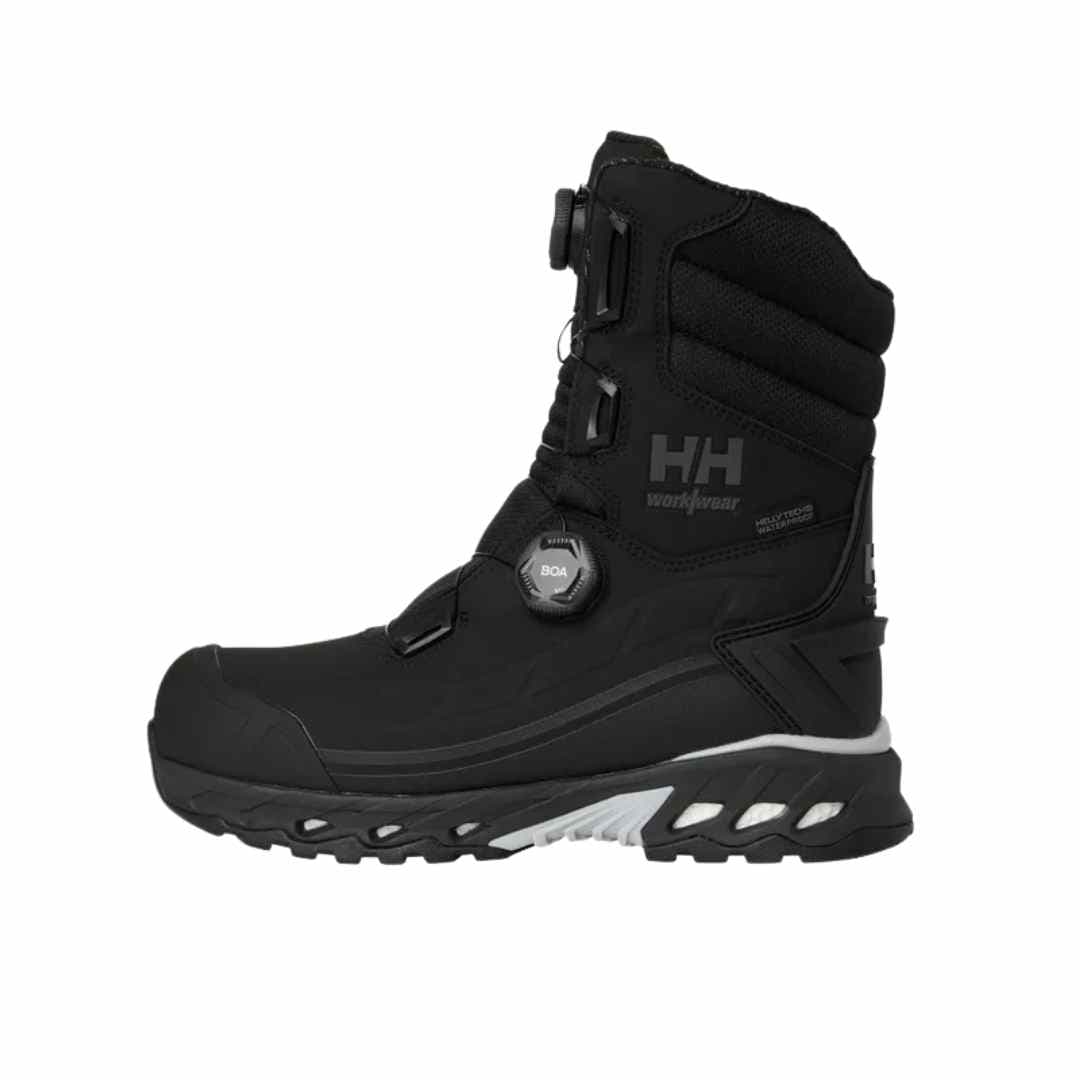
S7/winter — the new top class Has all the properties of S3, plus full waterproofness. These are the insulated safety shoes for a Northern Norwegian winter: with a membrane and lining, you stay dry and warm on the winter building site. Also available as S7L and S7S.
Additional markings explained
- P — penetration-resistant sole (metal)
- PL — penetration-resistant sole (textile, 4.5 mm nail)
- PS — penetration-resistant sole (textile, 3 mm nail)
- WR — waterproof shoe: the entire shoe is tested, including seams (Water Resistance)
- WPA — water-repellent upper: tests water penetration and water absorption in the upper material (replaces the former WRU)
- HRO — sole withstands contact heat up to 300 °C
- CI — insulated against cold
- HI — insulated against heat
- M — metatarsal protection
- AN — ankle protection
- CR — cut-resistant upper
- ESD — enhanced electrostatic dissipative properties (electronics industry)
- FO — oil-resistant sole (now an additional property, not a standard requirement)
- SR — slip-resistant (tested with glycerine on tiles)
- LG — ladder grip sole (Ladder Grip), new in 2022, for working on ladders
- SC — abrasion resistance on toe cap (Scuff Cap)
Which class do you need?
- Warehouse and workshop (indoors, dry): S1 or S1P
- Car mechanic: S2 or S3 (S3 if you work with heavy parts)
- Carpenter and joiner: S3 or S7 (S7 if you spend a lot of time outdoors in the rain)
- Electrician: S3 (with ESD marking if you work with sensitive electronics)
- Construction and civil engineering (outdoors, all conditions): S3 in summer, insulated S7/winter from October
- Road and asphalt work: S3 with HRO and HI (heat-resistant)
- Agriculture and forestry: S3, S5 or S7
- Fisheries and food industry: S4 or S5
- Cleaning and janitorial: S2 or S3 with good SR marking
- Fire and rescue: specialist footwear beyond the standard EN ISO 20345
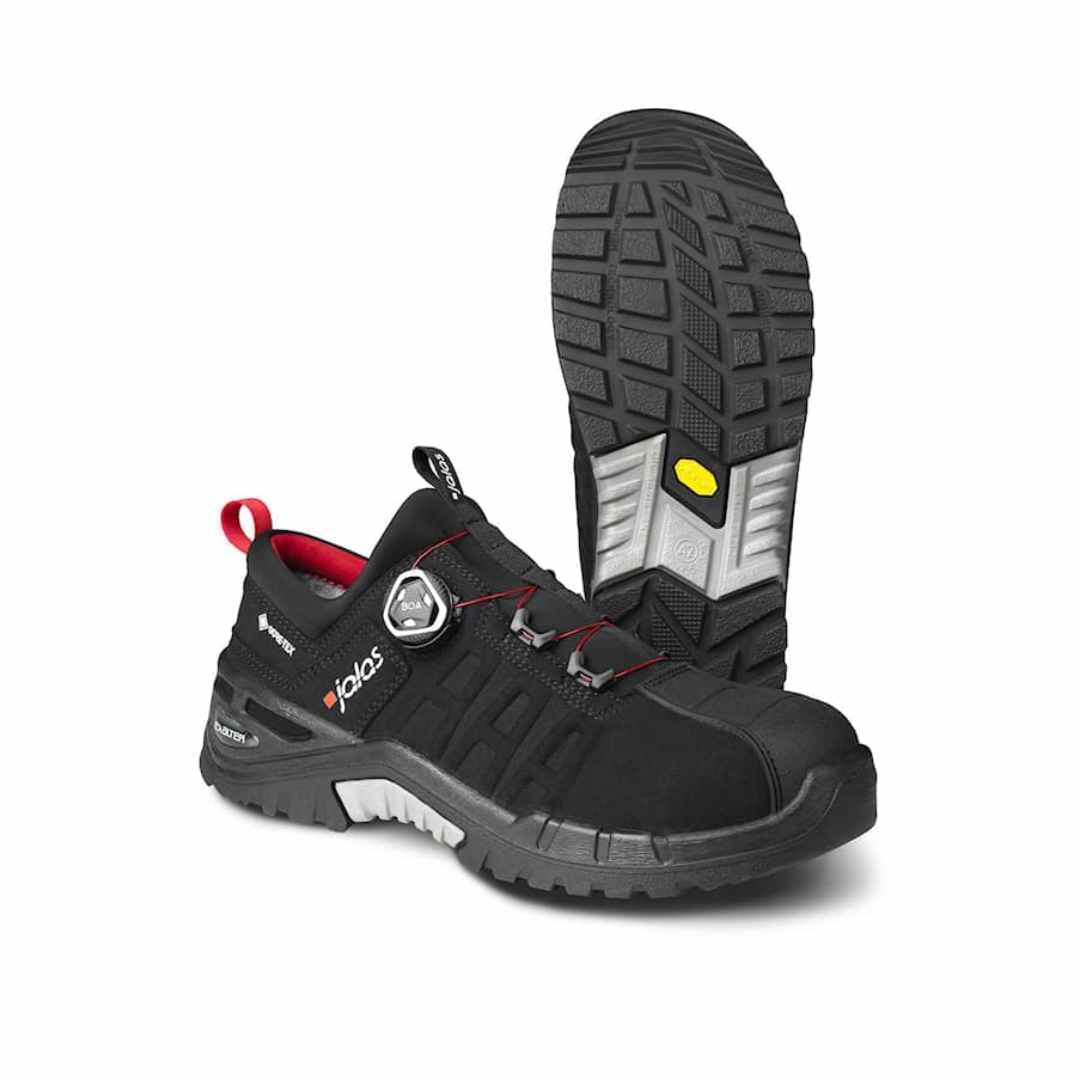
At our shop you will find safety shoes from Jalas and other quality suppliers — but fit matters more than the brand: if you stand for eight hours on a hard surface, the shoe must be tried on with the work socks you actually use.
Changes in the new 2022 standard — a brief summary
For those with previous experience of safety shoes, these are the most important changes:
- Two new classes: S6 and S7 with documented waterproofness (WR)
- WRU is replaced by WPA (water-repellent upper material), whilst WR means the entire shoe has been tested as waterproof
- SRA, SRB and SRC have been removed — replaced by a simpler SR marking. Basic slip resistance is now included in all shoes
- FO is no longer a standard requirement: oil-resistant sole is now an optional additional property
- P marking split: P means a metal plate, PL and PS mean a metal-free penetration-resistant midsole (tested with 4.5 mm and 3 mm nails respectively)
- New additional markings: LG (ladder grip sole) and SC (abrasion resistance on toe cap)
What to look for when buying
The correct safety class is just one of several criteria. Also consider:
Fit Safety shoes should fit well without pinching. Always try shoes on with the same type of socks you will wear at work. Bear in mind that feet swell slightly as the day goes on — try them on in the afternoon if possible.
Weight Heavy shoes take their toll on your legs over a long working day. Modern safety shoes with composite toe caps (instead of steel) are often considerably lighter.
Composite toe cap or steel Composite toe caps (plastic/carbon fibre) are lighter and do not conduct cold — comfortable in a cold climate like ours. Steel toe caps are less expensive and slightly more durable.
Breathability Long days in safety shoes can lead to sweaty, unpleasant feet. Shoes with a breathable lining (ideally Gore-Tex or similar) provide greater comfort.
Insoles Original insoles are often not the best option for long working days. Good ergonomic insoles provide better support and reduce strain on your back and knees.
Durability How long a pair lasts depends on how hard they are used. Check the quality of seams, adhesive and sole before buying, and replace the shoes when the sole is worn down, the upper is damaged or the toe cap is deformed.
Workwear built for the coast
Tromsø weather means wind and sleet during working hours too. Think in layers:
- Wool base layer next to the skin — wool keeps you warm even when damp.
- Mid layer — fleece or wool jumper.
- Outer layer — work jacket or shell jacket; hi-vis where the job requires visibility (EN ISO 20471).
Key brands we stock: Helly Hansen Workwear (largest range), Carhartt, ProJob, Univern and Snickers Workwear — plus corporate wear from Clique, Cutter & Buck, Nimbus and J. Harvest & Frost.
For businesses: Bedriftssenteret at Kvaløyvegen
Jobb og Fritid Bedriftssenter (Kvaløyvegen 329) is our centre for business customers:
- Branding with company logo (printing and embroidery)
- Corporate discount and invoiced payment
- Dedicated B2B online catalogue for ordering within your company's range
- Open Mon–Fri 07–16 — suited to the working day
Safety shoes can be tried and purchased at Jobb og Fritid Bedriftssenter at Kvaløyvegen 329 (Mon–Fri 07–16) — that is where we have the range and the expertise. Workwear is also available in our shops at Jekta and Veita, and everything can be ordered in the online shop.
Frequently asked questions
Which safety shoes are best for construction work in Tromsø? An S3 shoe in summer and an insulated winter safety shoe from October. Come into Bedriftssenteret at Kvaløyvegen with your work socks and we will find the right fit.
Can you supply workwear with a company logo? Yes — Bedriftssenteret handles branding, and business customers receive a corporate discount and can pay by invoice.
Do you stock hi-vis/high-visibility clothing? Yes, high-visibility garments in classes 1–3 from several of our workwear brands.
How long do safety shoes last? It depends on use. Replace the shoes when the sole is worn down, the upper is damaged, or the toe cap is deformed — a toe cap that has taken a hard impact must not be used further.
Can I wash safety shoes? Leather shoes should be brushed and treated with leather care products. Textile shoes can be wiped with a damp cloth. Avoid machine washing — it can damage the toe cap and adhesive.
Do I need safety shoes when I work alone as self-employed? In construction and civil engineering: yes — the requirements for personal protective equipment also apply to sole traders with no employees (forskrift om organisering, ledelse og medvirkning § 1-3 and chapter 15). In other industries it is your own responsibility to assess the risk, but safety shoes are equally sensible when the foot is exposed to falling objects or nails.
What is the difference between safety shoes and work boots? Safety shoes are certified to EN ISO 20345 with a toe cap and specific safety properties. Ordinary work boots without certification do not provide the same protection, even if they may look similar.
Does my employer cover safety shoes? The employer must make the necessary personal protective equipment available when the risk assessment shows that the work requires it (arbeidsmiljøloven and forskrift om organisering, ledelse og medvirkning chapter 15). Check the health, safety and environment procedures at your workplace for how it is arranged there.
Need help choosing?
We have extensive experience with safety shoes and workwear for all industries in Tromsø, and are happy to help you find the right equipment for your working situation. You can try on safety shoes at Jobb og Fritid Bedriftssenter at Kvaløyvegen 329, which also offers deals to businesses. Business customers receive a company discount and can pay by invoice, and we print or embroider company logos on workwear and protective equipment.
Sources
- Standard Norge – NS-EN ISO 20345:2022 Vernesko — current standard, published 2022, replaces the 2011 edition
- Standard Norge – NS-EN ISO 20345:2022/A1:2024 — the 2024 amendment
- Ejendals/Jalas – EN ISO 20345: krav til vernesko — the classes SB–S7, P/PL/PS, SR, WPA and WR
- Wenaas – EN ISO 20345:2022 Safety shoes — toe cap 200 J and what S1, S2, S3, S6 and S7 require
- Safety Jogger – EN ISO 20345:2022 — FO as optional marking, LG and SC, and the validity of 2011 certificates
- Lovdata – Forskrift om organisering, ledelse og medvirkning, kapittel 15 — the employer's obligations regarding personal protective equipment
Last checked 19.10.2026.